
Prime builds the robots, the stations, and the software that runs them — one system, one vendor accountable for the whole floor.
What took nine people now runs on one station and one arm.
Not a projection — running right now at a national 3PL.
// Prime customer outcome, in production
Systems in production
Integrated station types
Robot types, one platform
Typical ROI payback
Vendor for the whole floor
You already know the arms pick and the shuttles run. The risk you actually carry is whether the whole thing gets live, on time, and stays live — across complex buildings, mixed payloads, and more than one vendor.
Independent interviews with OEMs and integrators put delays at roughly one in five projects today — postponed, not because the technology failed, but because the project bogged down.
// STIQ G2P Solutions Report, 2025
Goods-to-person addresses the single largest cost element in a manual operation. That’s the prize — and the reason a stalled automation project is so expensive to live with.
// STIQ G2P Solutions Report, 2025
As projects skew smaller and buildings get older and messier, research finds flexible, reconfigurable systems are the ones being chosen — and multi-vendor complexity is what drags in integrators.
// STIQ G2P Solutions Report, 2025
So the question that matters isn’t do the robots work — it’s who owns the gaps between them. Below is exactly where projects stall, and how owning the whole system removes each seam.
A warehouse automation project moves through four stages. At each one, the conventional multi-vendor approach has a seam — a place the project slips. Pick the stage you’ve been burned at.
You’re handed a layout built around one vendor’s robots, a second vendor’s software assumptions, and a building they’ve never stood in. Aging racks, odd column spacing, mixed payloads — the things that actually decide feasibility — get discovered late.
Prime designs robots, stations, and PrimeOS as one system, so the spec is built around your building and your order mix — not forced to fit a catalog. Flexible, reconfigurable station sets mean the messy real-world site is the normal case, not the exception.
Robots from one vendor, control software from another, stations from a third, and an integrator hired to make them talk. Every handoff is a seam — and when something doesn’t line up, everyone points at everyone else while the schedule slips.
PES is the single brain. It executes orders across every device on the floor — Prime robots, manned and unmanned stations, and third-party conveyors, scanners, wrappers, and cranes. There’s no seam to fall through, and no integrator between you and a fix.
A big-bang cutover asks you to bet the building on a single switch-on date. If it slips — and the research says roughly one in five projects does — you’re carrying cost on a system that isn’t moving product yet.
Every station type is designed to run manned from day one. You add automation as your team adapts and the operation scales — so the floor keeps moving and the go-live seam never becomes a single point of failure.
Volumes shift, SKUs change, a line gets re-laid-out. With fixed infrastructure and hard-wired integrations, every change is a new engineering project — and another chance for the whole thing to stall again.
PrimeOS is a workflow composition engine and the fleet is mobile, so when the operation changes you reassemble the workflow — not the building. Flexibility isn’t a feature here, it’s how the system is built.
Recognize one of these? That’s the conversation to have. Get a private walkthrough →
One warehouse operating system — from your WMS to your dock door. PrimeOS orchestrates every robot, station, device, and workflow on your floor, Prime and third-party alike.
Inventory, orders, users, dashboards, and reporting — the operational intelligence layer managers live in daily.
The real-time execution engine. Assigns every task, manages every robot, orchestrates every device simultaneously.
Design any workflow with drag-and-drop. WorkFlow Builder turns floor rules into automated sequences. Dashboards show it running.
The always-on floor view. Real-time robot positions, station status, alerts, and exception management.
Battery management, predictive maintenance, robot health, and performance analytics across the full fleet.
Receive, store, pick, palletize, ship — every stage below is Prime hardware orchestrated by PES. Not four vendors stitched together. One system that owns the whole flow.
STAGE 01
MobilePallet AMRs move loads — no fixed conveyor.
STAGE 02
RackBot 4-way shuttle, high-density pallet ASRS.
STAGE 03
Goods-to-person each picking, 350+ per hour.
STAGE 04
Robotic mixed-SKU palletizing, up to 600 CPH.
Every arrow above is a handoff that, with separate vendors, becomes a seam. Here it’s one platform — so there’s nothing to fall through.
Each of these is a real problem operators face — and each has vendors who answer “you’ll need a system integrator for that.” Prime’s answer is the platform: one system that handles all of it.
Robotic mixed-SKU palletizing at full speed — arm + pallet AMR + Bullseye Scheduling that keeps the arm fed. The workflow most vendors avoid entirely.
350+ picks per hour per operator with MobileShelf AMRs — goods-to-person each picking at speed, fully reconfigurable as your operation evolves.
Every order type on the same floor, serviced by one hybrid station and orchestrated by PES. One operation — no integration gaps between workflows.
Arctic Series robots engineered for sustained sub-zero operation — cold-adapted hardware, no human required in the freezer. The full Prime platform, rated for cold chain from day one.
Robotic pallet building to full retail height — mixed SKUs, stable structure, consistent throughput. The operation that pushes every arm vendor to its limit.
PrimeOS is a workflow composition engine — assemble the blocks your factory needs, integrate with your ERP or MES, navigate mixed-traffic floors via SLAM. When the line changes, reconfigure in software.
High-density pallet ASRS with a 4-way shuttle — and unlike standalone ASRS vendors, RackBot ships with PrimeOS already integrated. Storage that executes orders, not just stores pallets.
Roboscans, pallet wrappers, third-party cranes, conveyors, turntables — PES integrates and orchestrates every device on your floor, not just Prime hardware. The integration nightmare, solved.
Not projections. Not analyst estimates. Results from Prime systems in production right now.
Before the Prime system we had 9 people doing what we can now do with 1 human station and 1 arm.
Regional distribution center · East Coast
With Prime’s robots and pick stations we were able to do with 1 employee what it would take 6–8 to do before we automated.
Northeast US · multi-facility operation
Reduction in picking labor
3PL customer — regional distribution center
Warehouses into one
National distributor — same throughput, one building
Typical ROI payback
vs. 24–36 months with a multi-vendor approach
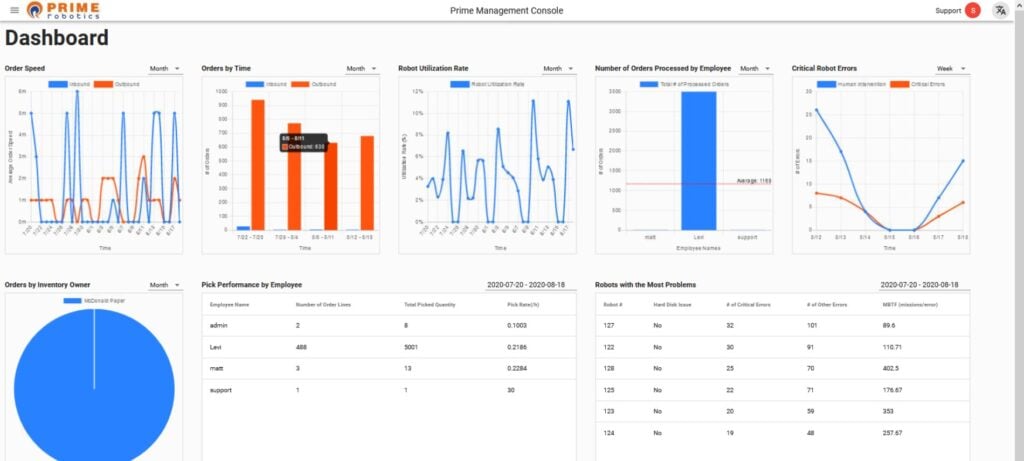
The same proof, on a live dashboard: order speed, utilization, and a critical-error line that trends toward zero.
The seam problem is settled above. What’s left is what you get to keep: one accountable team, progressive deployment, and American-supported operations you can see running in real time.
Prime designs and manufactures its own hardware and the PrimeOS platform that runs it. That’s the difference between robots taking generic commands and a system where the software uses behaviors we built on purpose. One roadmap. One accountable team. No OEM politics.
Station types designed to run manned from day one. Add automation as your team adapts and your operation scales. No big-bang cutover, no stopping production to implement — the seam at go-live, removed.
Real-time system monitoring with proactive issue resolution — most problems are fixed before you know they exist. Daily performance reports to your team. Not a promise, a dashboard.
Prime is headquartered in Denver, Colorado, and supported by an American team. When you call, someone answers — in your timezone, with full access to your system data. Most issues are resolved before you’re even aware of them.
HQ & support, Mountain Time
We’ll show you which station set fits your operation, walk through the deployment model, and tell you honestly whether the economics work for your situation — no pressure, no boilerplate deck.